Dodge 5.7 HEMI Coil Pack Firing Diagram and Dual-Plug Layout
Dodge and Ram 5.7 HEMI ignition guide covering firing order, cylinder numbering, 16 spark plugs.
The Chrysler 5.7L HEMI firing order is 1-8-4-3-6-5-7-2. Cylinders 1-3-5-7 are on the left/driver bank from front to rear, and 2-4-6-8 are on the right/passenger bank from front to rear in common longitudinal Dodge/Ram layouts. The engine has two spark plugs per cylinder, but the high-voltage routing changed: early systems use long secondary leads that cross to companion cylinders, while later systems fire both plugs of the same cylinder from that cylinder's coil. Identify the year, vehicle and actual coil/lead design before moving any wire.
A 5.7 HEMI has eight ignition coils but sixteen spark plugs. That unusual combination is why photographs from the wrong model year cause so many routing mistakes. One plug sits near the top of each combustion chamber and the second plug is reached from the opposite side of the cylinder head. Chrysler changed how the coil's secondary output reaches that second plug during the engine family's production run.
Start with the vehicle, not the keyword. Record the VIN, model year, Dodge/Ram/Chrysler/Jeep platform and engine sales code, then inspect whether the long leads cross between cylinders or remain associated with the same cylinder. Mopar's parts catalog is vehicle-configurable for the same reason: a part listed for one 5.7L installation is not proof of fitment or routing on another.
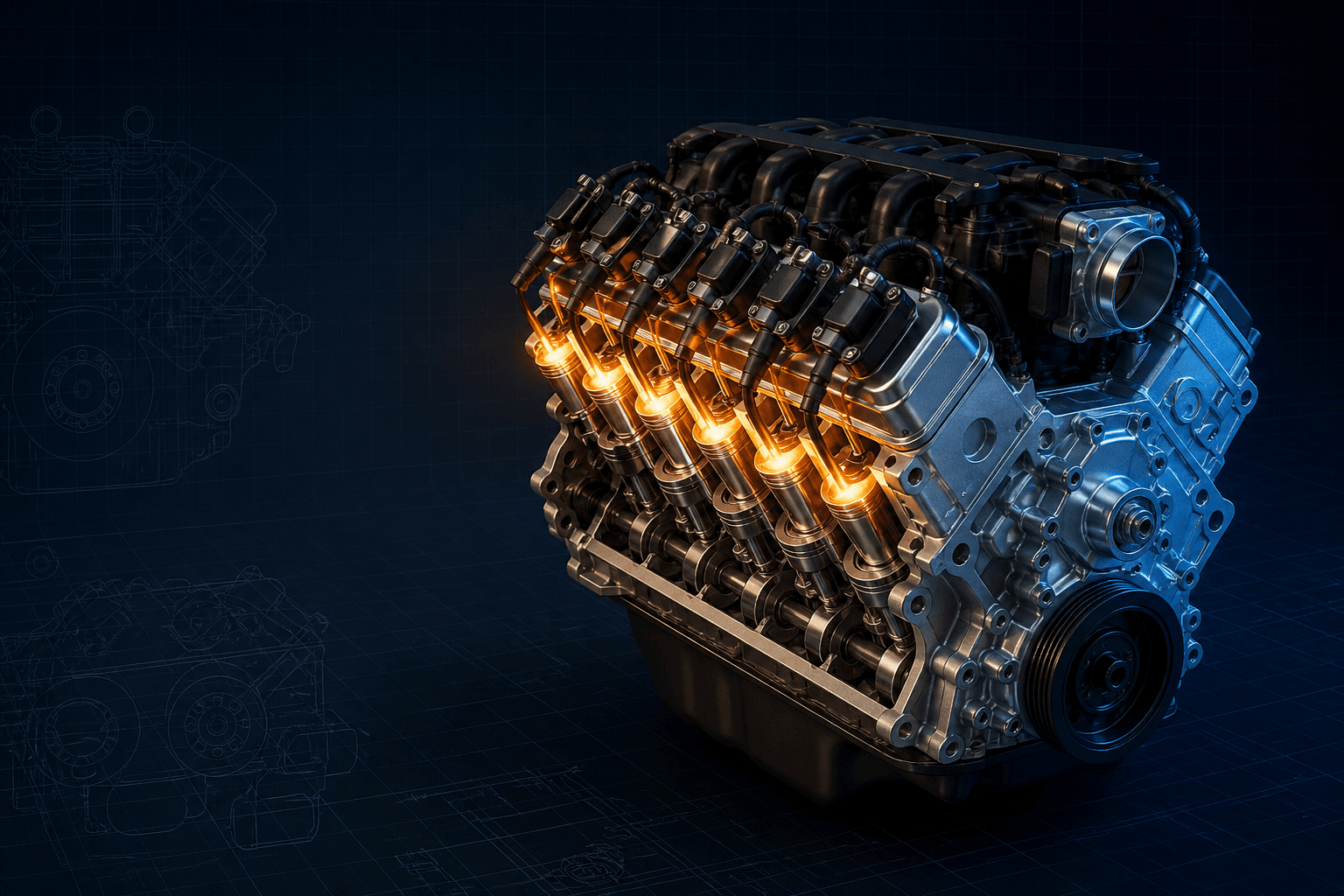
Interactive 5.7 HEMI dual-plug ignition map
Branded downloads includedPNG and PDF exports carry the TorqueSheet logo, torquesheet.com, source-page URL, and republishing attribution request. The PDF source link is clickable.
The map identifies banks, order and architecture. Select the VIN/year service diagram before assigning long-wire endpoints or connector pins.
Dodge 5.7 Hemi Coil Pack Firing Diagram
| APPLICATION / ITEM | SPECIFICATION | NOTES |
|---|---|---|
| Firing order | 1-8-4-3-6-5-7-2 | Verify against the exact service manual after swaps |
| Left/driver bank | 1-3-5-7 | Front to rear, longitudinal layout |
| Right/passenger bank | 2-4-6-8 | Front to rear, longitudinal layout |
| Spark plugs | 16 total | Two per cylinder; plug part and gap vary by year |
| Critical variant | Early crossover vs. later same-cylinder secondary | Inspect hardware before routing |
Do not use a later same-cylinder lead diagram on an early crossover-wire engine, or vice versa. The eight low-voltage coil connectors also have application-specific power splices, PCM driver circuits, colors and pin numbers that require the VIN-matched service schematic.
How to use this specification correctly
- 01
Record VIN, model year, platform, engine sales code and any engine/harness swap history.
- 02
Confirm all eight cylinder positions and label every coil connector, short boot and long secondary lead before removal.
- 03
Determine whether the engine uses the early companion-cylinder crossover strategy or a later coil that serves both plugs in its own cylinder.
- 04
Retrieve the exact Mopar service wiring and ignition-component diagram; compare connector face and terminal count before probing.
- 05
Replace or move only one component at a time. Keep secondary leads clipped away from exhaust heat, sharp shields and adjacent leads.
- 06
Use year-correct plugs and gap; the cited 2012 Ram guide is an example, not a universal 5.7 specification.
- 07
Clear faults and verify misfire counters under the original load. Stop if the MIL flashes or the catalyst overheats.
Cylinder map and firing sequence
In common longitudinal installations, odd cylinders 1-3-5-7 run front to rear on the left/driver bank and even cylinders 2-4-6-8 run front to rear on the right/passenger bank. The firing sequence 1-8-4-3-6-5-7-2 tells the controller when combustion should occur; it is not a physical connector-pin order.
After an engine swap, confirm orientation and controller calibration. A correctly routed high-voltage side will still misfire if the harness and PCM are from incompatible applications.
Early crossover-wire architecture
Early dual-plug HEMI layouts use a coil mounted at each cylinder plus a long secondary cable associated with the second plug circuit. Those leads can cross the intake area to a companion location, so replacing all of them without tags creates several plausible but wrong combinations.
Do not derive the exact crossover endpoint solely from the numerical firing order. Obtain the factory component-routing illustration for the model year, then match any molded cylinder markings and wire lengths without stretching or crossing hot surfaces.
Later same-cylinder dual-plug architecture
Later revisions changed the coils and secondary routing so each cylinder's coil serves both spark plugs for that cylinder. This reduces confusing cross-engine leads but does not make the electrical connector universal. Power distribution, PCM drivers, suppression components and harness branch lengths still vary by chassis.
If replacement coils have a different secondary tower or the existing leads do not naturally reach, stop and verify the part number by VIN. Adapters or forced routing can hide a generation mismatch.
Primary-circuit and misfire diagnosis
- Use P0301-P0308 to identify the misfiring cylinder, while remembering a fuel, compression or valve-train fault can set the same code.
- Treat P035x-style coil-primary codes as circuit clues, not automatic coil condemnation.
- Verify the ignition feed with the circuit loaded and the exact fuse/relay diagram.
- Inspect connector locks, terminal tension, ground paths and harness chafe before replacing the PCM.
- Check both plugs, the coil boot and the second-plug lead for the affected cylinder architecture.
- Never pierce sealed wiring casually or short a PCM coil driver with a low-impedance lamp.
Why plug specifications cannot be generalized
Mopar's 2012 Ram guide identifies a specific 5.7L plug and 0.043-inch gap for that application. Earlier and later HEMI calibrations can specify different plug designs, materials, heat ranges, gaps and replacement intervals.
Order plugs by VIN and follow the model-year manual for a cold-engine removal/installation process and torque. Two plugs per cylinder doubles the opportunities for thread damage, cracked ceramics and swapped leads.
Editorial verification status
The architecture guidance and Mopar source trail are published for safe identification, but TorqueSheet has not yet attached a complete set of model-year factory connector and crossover-wire figures. Treat this as a broad orientation page until those selectable application variants are verified.
Dodge 5.7L HEMI V8 specifications can change by model year, engine, platform, wheel, and installed component. Confirm the VIN or engine identity, part numbers, fastener condition, and the current manufacturer instructions before service.
Dodge 5.7 HEMI Coil Pack Firing Diagram and Dual-Plug Layout FAQs
What is the 5.7 HEMI firing order?+
The commonly specified order is 1-8-4-3-6-5-7-2. Confirm the controller and engine application after a swap.
How many spark plugs does a 5.7 HEMI have?+
Production Gen III 5.7L HEMI engines use two plugs per cylinder, sixteen total.
Why do HEMI spark-plug wires cross the engine?+
Some early dual-plug systems use a companion/crossover secondary-lead strategy. Later designs can route the second output to the same cylinder, so use the year-specific figure.
Are cylinders 1 and 2 on the same bank?+
No in the common longitudinal layout. Odd cylinders are on the left/driver bank and even cylinders are on the right/passenger bank.
Can I use a 2012 HEMI spark-plug gap for every year?+
No. The cited 2012 figure applies to that Ram guide; select the plug and gap by VIN and model year.
Technical sources
TorqueSheet favors engine- and component-specific manufacturer instructions over unsourced universal values.
1Mopar 2012 Ram 3500 5.7L ignition parts catalogMopar's VIN-configurable catalog confirms the application-specific ignition-coil and spark-plug parts used on a 5.7L Ram rather than treating every HEMI year as identical.↗22012 Ram 2500/3500 User Guide - 5.7L spark-plug specificationThe factory guide specifies the 5.7L spark-plug part/gap for this application and demonstrates why plug service data must be selected by model year.↗3Ram service-manual publication guidanceRam directs technicians to its comprehensive service and diagnostic manuals for application-specific diagrams, connector views and step-by-step tests.↗